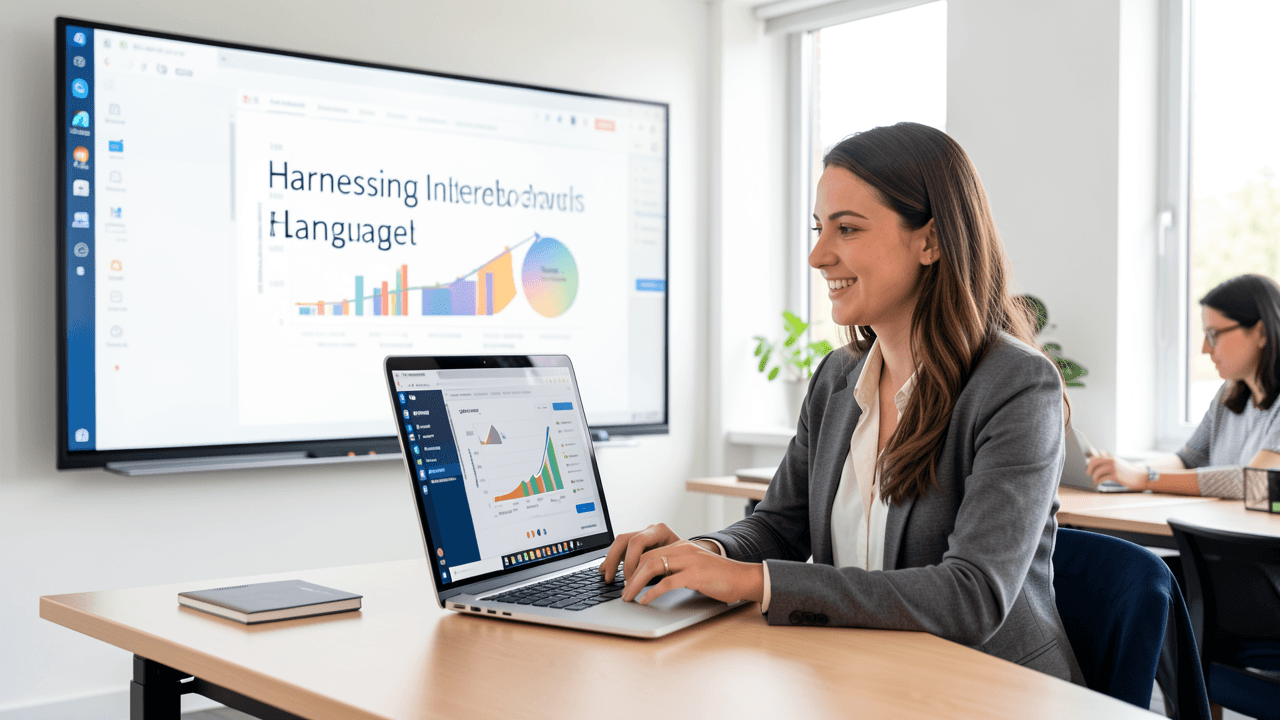
Harnessing Interactive Whiteboards in Language Learning
Interactive whiteboards (IWBs) have emerged as pivotal tools in the evolution of language education, promising to transform classrooms into dynamic learning environments. As we've progressed into 2025–2026, the integration of IWBs with advanced technologies is reshaping how language is taught and learned, especially for English education targeting Japanese and Korean speakers.
1. Latest Trends and Developments (2025–2026)
1.1 From “digital board” to connected teaching hub
Today’s interactive whiteboards do more than serve as digital blackboards. They act as central teaching hubs that connect various digital resources, thereby enhancing the learning experience. Modern IWBs are becoming the nerve center of classrooms, seamlessly integrating:
- Digital coursebooks and interactive texts
- Student devices and collaborative workspaces
- Video-conferencing platforms
- Learning management systems
- AI pronunciation and conversation tools
- Polling, quizzing, annotation, and formative assessment systems
Instead of being a passive display, the IWB is now a shared workspace where learners can manipulate language, negotiate meaning, present ideas, and receive immediate feedback.
1.2 AI-assisted language practice
The augmentation of IWBs with AI tools has paved the way for dynamic, personalized language practice. AI technologies are being employed for:
- Conversational practice through chatbots
- Pronunciation analysis and feedback
- Automated writing critiques
- Vocabulary personalization
- Grammar elucidation
- Role-playing and simulations
The IWB serves as an interface displaying AI-generated dialogues, facilitating analysis of student responses in real-time, and encouraging critical evaluation of automated feedback. A recent study reveals the exponential increase in research focusing on AI in language learning, highlighting its significance and potential.
1.3 Interactive texts and multimodal learning
Interactive digital texts are integral to communicative language teaching. By incorporating text, audio, video, images, animations, and clickable vocabulary and grammar support, these texts enhance multimodal learning. Explore more about these living textbooks here.
The IWB allows teachers and students to:
- Highlight text evidence within stories
- Reorder dialogues and predict narrative developments
- Compare formal and informal language
- Review and annotate texts collaboratively
- Convert reading passages into role-plays
This form of engagement enriches the learning experience, merging traditional learning methods with digital interactivity.
1.4 Communicative and interactional pedagogy
Central to effective language teaching is the integration of Communicative Interactional Pedagogy (CIP), which emphasizes meaningful interaction and real-world communication. In practice, this involves designing tasks where students:
- Exchange information by asking and answering real questions
- Clarify misunderstandings and negotiate meaning
- Collaborate in decision-making
- Respond naturally to peers, thereby enhancing language competency
Research from TESOL suggests that IWBs can significantly support synchronous communication and interaction amongst learners, especially beginners.
1.5 Hybrid and blended learning
The integration of hybrid and blended learning models with IWBs allows for greater flexibility and access to educational resources. These models combine in-person instruction with digital learning platforms, accommodating varied learning styles and schedules.
Leveraging IWBs can provide students with access to diverse resources and personalized learning paths, fostering an inclusive educational environment.
Exploring the Future of Language Education with IWBs
Interactive whiteboards are undeniably reshaping the landscape of language education. By evolving from a basic digital display to a sophisticated educational hub, they provide a collaborative platform that supports interaction, multimodal learning, and immediate feedback.
As we move forward, the fusion of AI tools and IWBs is set to redefine language education, making it more interactive, personalized, and effective. Whether it's through advanced conversation simulations or interactive digital texts, educators now have unprecedented opportunities to create engaging and impactful learning experiences.
For educators seeking to innovate their teaching practices, the future of language education lies in embracing these technological advancements.
FAQs
Q: How do IWBs enhance language learning?
A: IWBs enhance language learning by providing an interactive and engaging platform that supports multimodal input, immediate feedback, and enables collaborative tasks.
Q: What role does AI play in interactive language education?
A: AI aids in providing personalized learning experiences, offering pronunciation analysis, conversational practice, and automated writing feedback, making language education more effective.
Q: How can teachers integrate IWBs into their curriculum?
A: Teachers can incorporate IWBs by using them to display interactive texts, facilitate role-plays, conduct formative assessments, and integrate AI tools into their language instruction.
For more on the evolution of language learning techniques, visit our insights on spaced repetition and explore various real-world teaching scenarios.