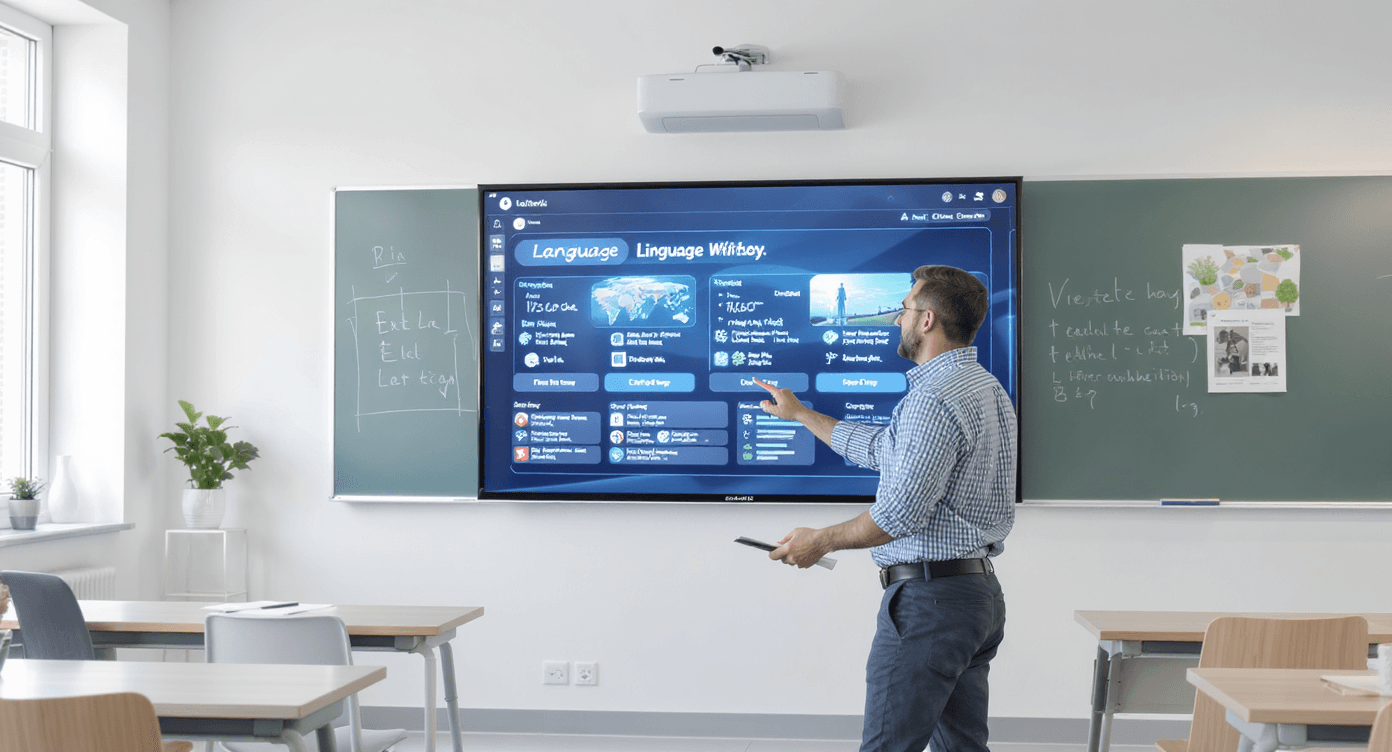
Interactive Whiteboards: Future of Language Teaching
In today's fast-paced educational environment, technology has seamlessly intertwined with pedagogy to enhance learning experiences. Among the latest advances, interactive whiteboards stand out as transformative tools in modern language classrooms, especially for teaching English to Japanese and Korean speakers. As we venture into 2025–2026, these whiteboards have evolved into sophisticated 'lesson hubs' that amalgamate AI-powered support and multimodal teaching strategies.
Why Interactive Whiteboards?
Interactive whiteboards have revolutionized how educators deliver lessons, maximize student interaction, and personalize experiences. They sit at the crux of communicative language teaching (CLT) and AI-powered EdTech, providing a dynamic platform for educators to leverage live interaction, rich media, and data-driven personalizations.
Communicative Language Teaching
Communicative Language Teaching emphasizes real-world communication and meaningful interaction. The shift from static textbooks to the vibrant, collaborative platforms provided by interactive whiteboards aligns perfectly with this approach. By anchoring lessons in shared interactive spaces, educators encourage speaking, collaboration, and tasks connected to real-life applications.[6]
AI-Powered EdTech Revolution
AI has transitioned from being a novel concept to becoming an integral teaching assistant. Within the context of language teaching, generative AI contributes by drafting lesson variants, generating leveled texts, and providing initial feedback on student work. This evolution allows educators to shift their primary focus towards pedagogy and fostering relationships with learners, a concept affirmed by edtech researchers.[2][3][4]
Multimodality and Real-World Communication
The rise of multimodal and immersive learning tools is another crucial trend. By integrating text, audio, video, images, and interactive tasks, language educators can offer diverse and enriched experiences to students. The use of interactive whiteboards, equipped to handle such modalities, facilitates this integration effortlessly. In Japan and Korea, where the emphasis on pragmatic and employability skills is growing, this is especially pertinent as it mirrors real-world communication scenarios without geographical constraints.[11]
The Interactive Whiteboard as a "Living Textbook"
Gone are the days of static printed coursebooks. Interactive whiteboards are being leveraged as 'living textbooks,' centralizing all learning activities into a coherent, immersive experience — a trend increasingly visible across schools. By supporting school-produced digital resources, these whiteboards enable teachers to design unique digital materials such as slides, drag-and-drop tasks, interactive timelines, and multimodal texts, often supported by AI content generation.[7]
For further insights, readers might be interested in our blog on The Living Textbook: conversations become curriculum.
AI's Role in Lesson Planning and Feedback
AI tools significantly aid lesson planning, enabling teachers to craft graded reading texts, comprehension questions, role plays, and pronunciation scripts, which are then effectively structured as interactive whiteboard lessons. In some innovative schools, AI is employed for real-time writing or speaking feedback, with anonymized student work displayed for class-wide discussion and collaborative revision.
Fostering Collaboration and Real-World Learning
Interactive whiteboards thrive when educators treat them not just as presentation screens but as interactive canvases. Teachers are creating collaborative, output-driven tasks wherein students actively engage with content on the board, thus mirroring authentic communication contexts.
Spaced repetition systems integrated into these whiteboards enhance vocabulary retention and practical language use, further aligning classroom tasks with real-world needs. Check out our article on Spaced Repetition in Language Learning for a deeper dive.
Translanguaging and Multilingualism
Translanguaging, or the use of learners' full linguistic repertoires, is increasingly valued, particularly in environments where multiple languages intertwine. This practice empowers students to draw on their native languages, making learning more inclusive and effective.[3]
Conclusion: A Future of Integrated Learning
As we progress towards 2026, the pedagogy surrounding interactive whiteboards exemplifies a holistic shift in language teaching. By embracing AI-supported, multimodal, real-world, and personalized learning, educators can foster environments where language learning becomes a natural, integrated part of daily life.
By staying informed about real-world teaching scenarios and leveraging the capabilities of interactive whiteboards, educators can ensure that language teaching remains relevant, engaging, and effective.
FAQs
Q1: How do interactive whiteboards differ from regular whiteboards?
Interactive whiteboards offer digital interactivity, allowing users to manipulate content and integrate multimedia resources, unlike standard whiteboards, which are primarily used for manual writing.
Q2: Can interactive whiteboards support students with diverse language backgrounds?
Absolutely! They accommodate translanguaging and multilingual practices, thus supporting diverse linguistic repertoires and enhancing inclusivity.
Q3: How is AI integrated into language teaching through whiteboards?
AI assists in lesson planning, generating graded materials, and offering real-time feedback, freeing teachers to focus on student engagement and pedagogical strategies.[4][16]
For authorized and in-depth resources, visit jalt.org and kotesol.org.