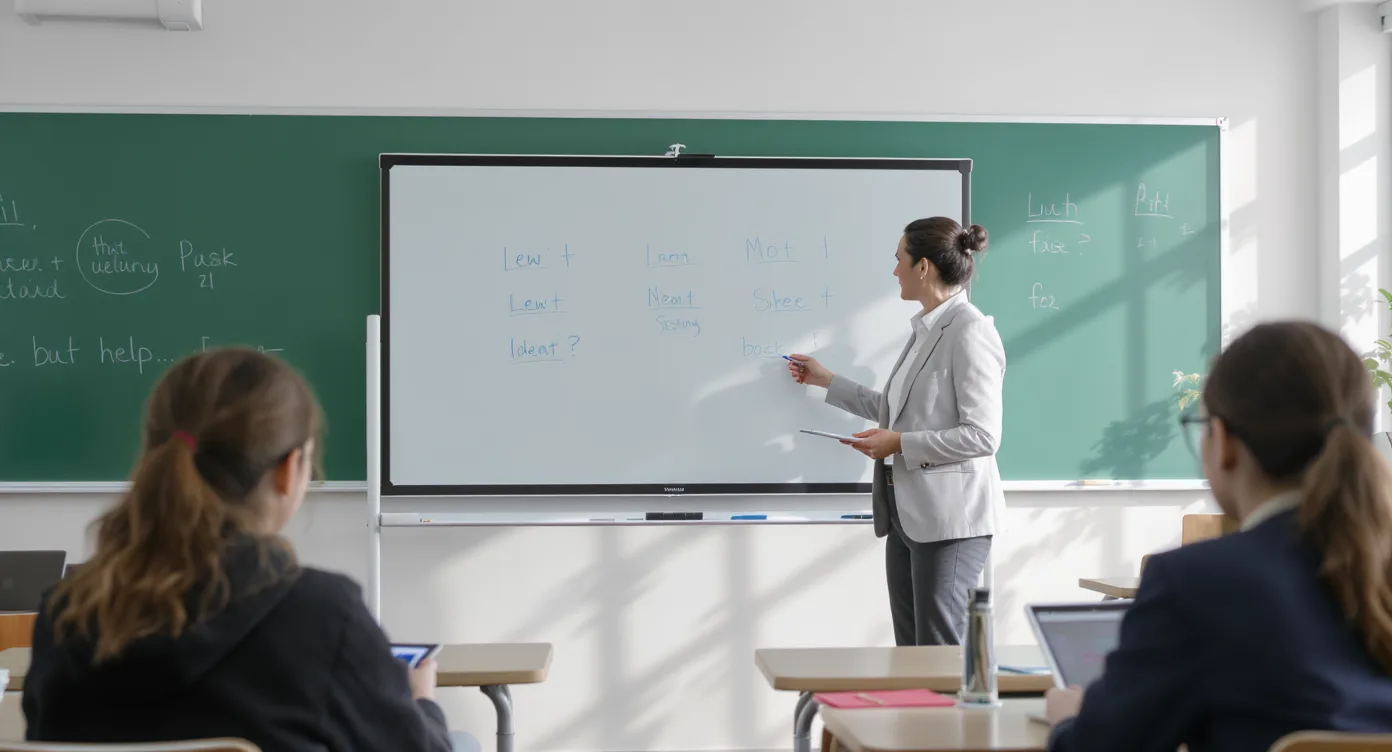
Transforming Language Education: Modern Interactive Whiteboards
Language teaching has transformed dramatically in recent years. A key player in these advancements? Interactive whiteboards (IWBs). By integrating emerging technologies like AI and VR, IWBs redefine classroom experiences, addressing challenges faced by educators and learners alike. Let's dive into how modern IWBs change the landscape of language education, focusing specifically on teaching English to Japanese and Korean speakers.
Emerging Trends in Language Education
In 2026, education trends lean towards AI-powered personalization, multimodal literacy, and human-centric interactions. Interactive whiteboards are central to bringing these concepts to life.
AI as a Co-Teacher
The integration of generative AI in IWBs allows for real-time adaptability. Customizable lesson plans, AI-driven feedback, and personalized tasks align with frameworks like the Global Scale of English (GSE), providing a streamlined path to mastery. Research indicates that learners benefit immensely from such personalized attention, achieving 40% faster progress. Source: ResearchGate
Immersive Learning with VR
IWBs also serve as hubs for VR-enhanced immersive learning. Language classrooms transform into vibrant cultural settings like Parisian cafés or bustling Tokyo boardrooms, allowing learners to practice in context-rich environments. Such innovation boosts engagement and comprehension significantly. Source: TESOL
Purpose-Driven Micro-Learning
More learners are gravitating towards shorter, goal-oriented learning sessions. IWBs, with wearable tech synchronization, propel these micro-learning experiences by providing context-specific prompts, ideal for real-world applications like business English or local accent acquisition.
Reviving In-Person Interactions
With the resurgence of in-person encounters, IWBs leverage “back-to-basics” methodologies, supporting teaching approaches that prioritize human connections, thus combating screen fatigue. Techniques like the Dogme approach are revitalized, creating a balanced blend of technology and traditional learning.
Case Studies in Real-World Implementation
Explore how IWBs are deployed in diverse educational environments, proving their efficacy.
Pearson Language Schools
At Pearson Language Schools, teachers utilize IWBs aligned with GSE standards. They map activities to GSE “can-do” statements, allowing real-time progress tracking in EFL settings. The results are tangible, showing streamlined decision-making and visible growth in students’ language abilities. Source: JALT
VR-Enhanced Institutes
Many educational institutions integrate VR with IWBs for experiential language practice. Schools report increased student engagement when learning through AI-native dialogues in scenarios like Spanish airports or cultural festivals.
Community-Led Programs
Community programs utilize IWBs for peer mentoring through virtual cafés, focusing on group scenarios like relocation preparation. This method shifts teacher roles toward facilitators, encouraging a more dynamic and inclusive learning environment.
Overcoming Common Challenges
While IWBs transform language education, educators face challenges such as over-reliance on AI and data overload. However, IWBs offer solutions like hybrid Dogme methods to balance face-to-face interactions and actionable insights from data metrics.
Internal and External Resources
For more insights into language teaching methods, check our blogs on Communicative Language Teaching, Teaching English to Japanese Speakers, and Teaching English to Korean Speakers.
Access further authoritative resources from Loka, British Council, and TESOL.
Frequently Asked Questions
What makes interactive whiteboards unique in language teaching?
Interactive whiteboards offer a multimodal teaching platform, integrating AI and VR for personalized and immersive learning experiences that are difficult to achieve with traditional methods.
How does AI enhance IWBs in education?
AI in IWBs provides real-time adaptations in teaching, personalized feedback, and leveled learning materials, facilitating more efficient and customized student learning paths.
Why are IWBs becoming essential in language learning environments?
IWBs offer a balance of technological integration with traditional teaching, enabling multimodal learning while supporting face-to-face interactions, essential for language acquisition.
How do IWBs aid in addressing screen fatigue?
IWBs support hybrid teaching methods that combine screen-based instruction with interactive, in-person activities, minimizing screen fatigue while enhancing engagement.
By harnessing the power of modern technologies, interactive whiteboards stand as pivotal instruments in reshaping language education, promoting a future where learning is both engaging and effective.