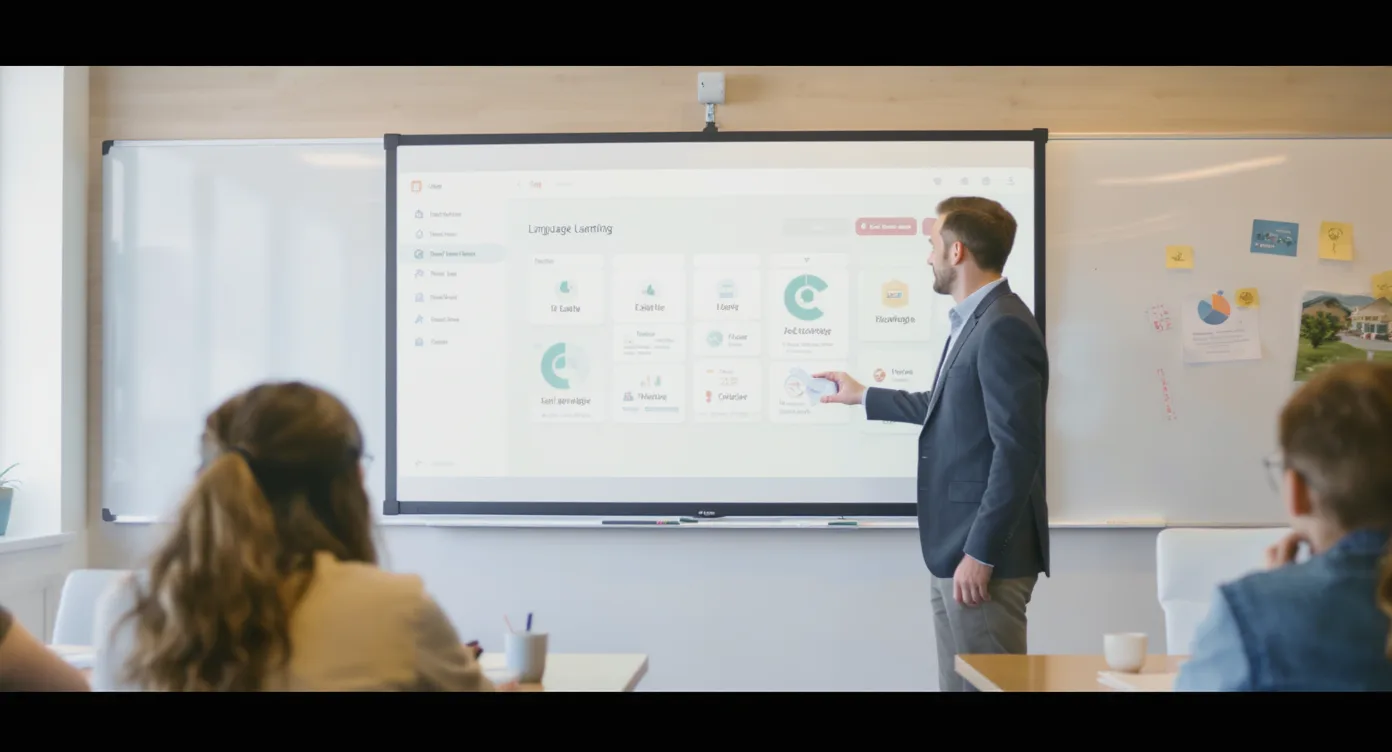
Revolutionizing Language Education with AI-Driven Interactive Whiteboards
Introduction
Interactive whiteboards (IWBs) are not just tools for displaying static content anymore; they are at the heart of a transformative shift in language education. In 2025-2026, these dynamic platforms are evolving into AI-enhanced, multimodal hubs that cater to both language educators and learners' needs, aligning with hybrid "high-tech, high-touch" models. This blog dives into how these advancements offer innovative teaching and learning experiences, especially in teaching English to Japanese and Korean speakers.
Latest Trends in Language Education
The integration of artificial intelligence and virtual reality into IWBs is leading the charge for dynamic and interactive language teaching environments. Key trends in 2025-2026 are reshaping the educational landscape:
Hybrid AI-Human Partnerships
AI-driven IWBs provide instant feedback on grammar and pronunciation. This technological assistance enables educators to focus on developing students' cultural intelligence and facilitating real, meaningful conversations, crucial in communicative language teaching. Despite a slight decline, English continues to dominate the language education enrollment at 63.3% globally, while interest in regional languages like Vietnamese and Hindi is surging.
VR/AR Integration
Immersive virtual reality scenarios are becoming commonplace in language classrooms, displayed on IWBs. This offers learners opportunities to engage in group immersion, such as practicing conversations in a simulated Parisian café or a Tokyo boardroom.
Micro-Learning and Wearables
IWBs are increasingly syncing with smart devices, allowing for context-aware lessons. This means students could receive location-based vocabulary during class simulations, enhancing the relevance and retention of the material taught.
Social and Cultural Focus
IWBs are pivotal in fostering global communities and facilitating peer mentoring. By blending in-person interactional methods with digital tools, they enable a focus on social and cultural aspects, which are increasingly important in globalized language learning environments.
Multimodal Literacy
With support for video, subtitles, and AI phrasing suggestions, IWBs help develop multimodal literacy, incorporating various digital formats in daily life.
Real-World Implementation: Case Studies
Various language institutions have successfully integrated IWBs into their teaching strategies:
- Berlitz Language Schools uses hybrid IWBs to combine AI-based drills with human-led cultural intelligence sessions, supporting the rise of Vietnamese and Hindi in Asia and European languages in LATAM regions.
- Mondly VR and ImmerseMe integrate VR scenarios onto IWBs, simulating environments like Spanish airports or French markets, boosting conversational confidence in students.
- Duolingo Max uses IWBs to display AI-powered conversations, enhancing peer exchanges in European language schools, reflecting a resurgence in in-person teaching methods like Dogme.
- HelloTalk-Enhanced Classrooms hold virtual café conversations on IWBs, connecting Latin American learners with Korean/Asian partners amid growing interest in Italian and other languages.
- Oculus Education pilots project VR worlds on IWBs for emergency simulations, focusing on communicative skills in English Language Development programs.
Cutting-Edge IWB Solutions
| Challenge | IWB-Centric Solution | |--------------------------------------|-------------------------------------------------------------------------------| | Screen fatigue/distraction | Use IWBs for varied interactive formats, including VR immersion to engage students.| | Lack of cultural context in lessons | Incorporate VR scenarios for real-life language application and cultural immersion.| | Limited personalization | AI adjusts lesson difficulty in real-time, customizing learning experiences. |
Conclusion
The advancements in interactive whiteboard technology are revolutionizing language education, promising an enriched learning environment that leverages AI, VR, and real-time collaboration. For platforms like LokaLingo, focusing on these advancements offers a competitive edge, especially in teaching English to speakers of Japanese and Korean. By embracing these technologies, educators can transform the language teaching landscape into a more engaging, culturally enriched, and effective experience.
Frequently Asked Questions (FAQ)
What makes interactive whiteboards effective for language teaching? Interactive whiteboards offer a dynamic platform for incorporating AI-driven feedback, VR scenarios, and collaborative opportunities that drive engagement and improve language acquisition.
How do IWBs support cultural understanding in language learning? IWBs integrate VR/AR technology for immersive, real-world scenarios, helping learners understand cultural contexts and apply language skills more aptly.
Are interactive whiteboards limited to English language instruction? No, while English remains a primary focus, interactive whiteboards are increasingly used for other languages, catering to regional language surges such as Vietnamese and Hindi.
For more insights on enhancing language education, explore our posts on Communicative Language Teaching, Teaching English to Japanese Speakers, and Teaching English to Korean Speakers.